Omega-3s Revisited: Why Recent Trials Are Forcing a More Nuanced View
Vannoni ©2026
For years, fish oil seemed like a simple solution for heart health. You'd see the supplements at every pharmacy, hear about them from friends, and maybe even take them yourself. The message was straightforward: omega-3s are good for your heart, so take fish oil pills.
But recent research has shown that the omega-3 story is more complicated than we thought. It turns out that not all omega-3s work the same way, the amount you take matters a lot, and getting them from food might be very different from taking a pill.
What Changed? Why Studies Have Made Us Rethink Everything
In 2018, researchers published three major studies on omega-3s, and they told very different stories. This created a lot of confusion,even among doctors.
One study called REDUCE-IT found something remarkable: when patients with high triglycerides (a type of fat in the blood) took a high dose of purified EPA, one specific type of omega-3, their risk of heart attacks and strokes dropped by 25%. That's a significant benefit.
But two other studies published the same year, VITAL and ASCEND, found almost no benefit from omega-3 supplements. They used a combination of two types of omega-3s (EPA and DHA) at lower doses and didn't see the same heart protection.
Then in 2020, another large study called STRENGTH was stopped early because the omega-3s being tested weren't helping patients at all, even though researchers were using high doses.
So what's going on? Why do some studies show omega-3s work while others don't?
It's Not Just About Taking Omega-3s—It's About How Much and What Kind
One of the biggest lessons from recent research is that the dose really matters. Think of it like medication: taking a small amount might not do anything, but the right dose can make a real difference.
The studies that showed the most benefit used 4 grams (4,000 milligrams) of omega-3s daily. That's much higher than what most over-the-counter fish oil pills contain. A typical fish oil capsule has maybe 300-500 mg, so you'd need to take 8-10 pills to get to 4 grams, and that's neither practical nor recommended without your doctor's supervision.
But there's another twist: the type of omega-3 matters just as much as the amount.
EPA vs. DHA: Not All Omega-3s Are Created Equal
Most people don't realize there are different types of omega-3 fatty acids. The two main ones found in fish are:
EPA (eicosapentaenoic acid)
DHA (docosahexaenoic acid)
For years, we assumed they worked the same way. But recent research suggests that EPA alone might be better for heart protection than combinations of EPA and DHA.
The REDUCE-IT study, the one that showed the big benefit, used only EPA. Meanwhile, studies that used EPA and DHA together showed less benefit or no benefit at all. Scientists are still trying to understand exactly why, but it appears that DHA might actually interfere with some of EPA's heart-protective effects.
This is important because most over-the-counter fish oil supplements contain both EPA and DHA. Only prescription omega-3 products give you pure, high-dose EPA.
Get The Meyer Nutrition Plan
What If You're Already Taking a Statin?
Many of my patients ask: "If I'm already taking a statin for cholesterol, will omega-3s still help me?"
This is one of the most important questions, because most people at risk for heart disease are already on statins. The good news is that omega-3s can still provide additional benefit—but only in specific situations.
The key is understanding that statins and omega-3s work differently. Statins lower your LDL cholesterol (the "bad" cholesterol). Omega-3s lower triglycerides, which are a different type of fat in your blood. They also help reduce inflammation in your blood vessels.
In the REDUCE-IT study, all the patients were already on statins with their LDL cholesterol under control, but they still had high triglycerides. Adding high-dose EPA on top of their statin reduced their heart attack and stroke risk significantly.
So if you're on a statin but your triglycerides are still elevated (generally above 135-150 mg/dL), talk to your doctor about whether prescription omega-3 therapy might help.
Join Our Concierge Membership Program
Should You Eat Fish or Take Supplements?
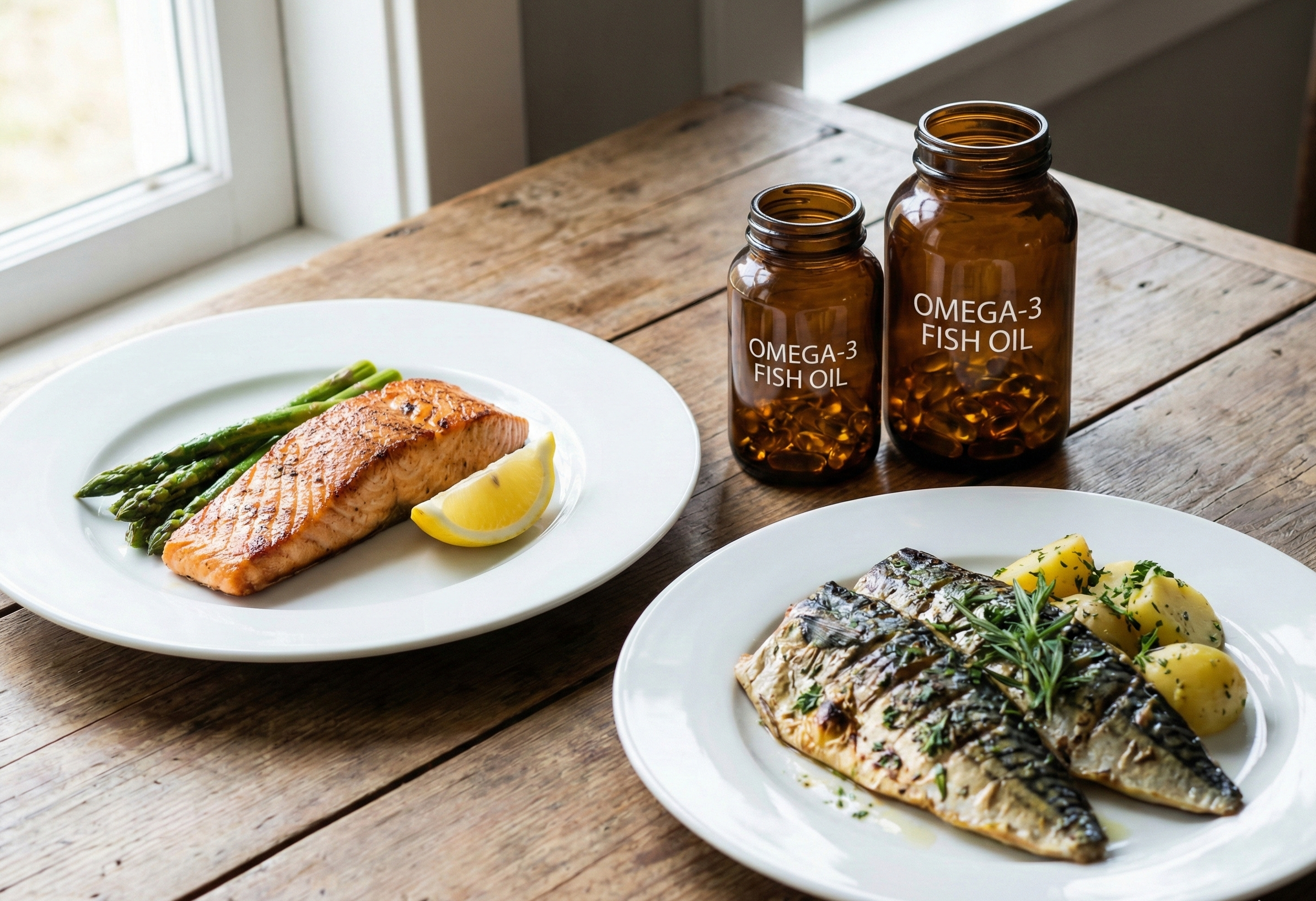
Here's where things get really interesting: eating fish appears to be better for your heart than taking fish oil pills.
Study after study has shown that people who eat fatty fish like salmon, mackerel, or sardines a few times a week have significantly lower rates of heart disease. In fact, eating fish just twice a week can cut your risk of dying from heart disease nearly in half compared to eating no fish at all.
Why might eating fish be better than supplements? A few reasons:
Fish is more than just omega-3s. When you eat salmon or mackerel, you're also getting high-quality protein, vitamin D, selenium, and other nutrients that work together to protect your heart. A pill only gives you the omega-3s.
Food substitution matters. When you eat fish for dinner, you're probably not eating a steak or fried chicken. That swap—from red meat to fish—has its own heart benefits that a supplement can't replicate.
Your body absorbs them differently. The omega-3s in fish may be absorbed and used by your body more effectively than those from supplements.
The American Heart Association still recommends eating at least two servings of fatty fish per week as the foundation of omega-3 intake. Supplements should be considered only for specific situations, not as a replacement for food.
So What Should You Actually Do?
Based on all this research, here's my practical advice:
If you're healthy and want to prevent heart disease:
Focus on eating fatty fish twice a week (salmon, mackerel, sardines, trout)
Add plant sources like walnuts, flaxseeds, and chia seeds to your diet
Skip the over-the-counter fish oil supplements unless you rarely eat fish
If you do take supplements, don't expect them to compensate for an unhealthy diet
If you have heart disease or high triglycerides:
Keep taking your prescribed medications (especially statins)
Still eat fatty fish regularly—food matters even when you're on medication
Talk to your doctor about prescription omega-3 therapy if your triglycerides remain high
Don't substitute over-the-counter fish oil for prescription products—they're not the same
Important things to know:
Over-the-counter fish oil is not the same as prescription omega-3 medications
High doses of omega-3s can increase the risk of irregular heartbeat in some people
Omega-3s can increase bleeding, especially if you're on blood thinners
Always talk to your doctor before starting any supplement
~ Don’t Have To wait To Hear About The Newest Study - Be At The Center of State-of-the-Art Healthcare ~
Join Madison Avenue Concierge Medicine, Book a Consultation with Dr. Meyer
Why Doesn’t It One-Size-Fit-All?
The omega-3 story shows us that simple answers in medicine are rare. We've learned that:
Dose matters: Low doses probably don't help much for heart protection
Type matters: EPA alone may be better than EPA+DHA combinations
Who takes them matters: Benefits are clearest in people with high triglycerides on statins
Food matters: Eating fish is better than taking pills for most people
For most healthy people, the focus should be on eating more fatty fish, not on buying supplements. But for specific high-risk patients, particularly those with persistently high triglycerides despite statin therapy, prescription high-dose EPA can be a valuable addition to their treatment plan.
The days of generic "fish oil for everyone" recommendations are over. Instead, we now have a more sophisticated understanding that allows us to target omega-3 therapy to the patients most likely to benefit.
If you're wondering whether omega-3s, from food or supplements, are right for your heart health, the best answer will depend on your individual risk factors, cholesterol levels, current medications, and diet. That's a conversation worth having with your cardiologist.
Sources
National Center for Biotechnology Information (NCBI). "Recent Clinical Trials Shed New Light on the Cardiovascular Benefits of Omega-3 Fatty Acids." PMC, 2019. https://pmc.ncbi.nlm.nih.gov/articles/PMC6822654/
National Center for Biotechnology Information (NCBI). "N-3 Fatty Acids (EPA and DHA) and Cardiovascular Health - Updated Review of Mechanisms and Clinical Outcomes." PMC, 2024. https://pmc.ncbi.nlm.nih.gov/articles/PMC12628397/
eClinicalMedicine (The Lancet). "Effect of omega-3 fatty acids on cardiovascular outcomes: A systematic review and meta-analysis." July 2021. https://www.thelancet.com/journals/eclinm/article/PIIS2589-5370(21)00277-7/fulltext
European Journal of Preventive Cardiology. "Effects of omega-3 fatty acids on coronary revascularization and cardiovascular events: a meta-analysis." October 2024. https://academic.oup.com/eurjpc/article/31/15/1863/7692830
Cleveland Clinic. "Omega-3 Fatty Acids & the Important Role They Play." 2017. https://my.clevelandclinic.org/health/articles/17290-omega-3-fatty-acids
National Institutes of Health (NIH) - Office of Dietary Supplements. "Omega-3 Fatty Acids: Fact Sheet for Health Professionals." Updated January 2025. https://ods.od.nih.gov/factsheets/Omega3FattyAcids-HealthProfessional/
National Geographic. "Omega-3s are great for your health—but supplements may not be." March 2025. https://www.nationalgeographic.com/health/article/omega-3s-fish-oil-supplements
British Heart Foundation. "Omega-3 foods for heart health." October 2025. https://www.bhf.org.uk/informationsupport/heart-matters-magazine/nutrition/omega-3s-and-your-heart
Harvard Health Publishing. "Omega-3 fatty acids and the heart: New evidence, more questions." March 2021. https://www.health.harvard.edu/blog/omega-3-fatty-acids-and-the-heart-new-evidence-more-questions-2021032422213
American Heart Association - Circulation. "Omega-3 Fatty Acids and Heart Health." https://www.ahajournals.org/doi/10.1161/circulationaha.114.015176
American Heart Association - Circulation. "Omega-3 Fatty Acids for the Management of Hypertriglyceridemia: A Science Advisory." 2019. https://www.ahajournals.org/doi/10.1161/CIR.0000000000000709
MDPI - Nutrients. "Omega-3 (n-3) Fatty Acid–Statin Interaction: Evidence for a Novel Therapeutic Strategy for Atherosclerotic Cardiovascular Disease." April 2024. https://www.mdpi.com/2072-6643/16/7/962
European Journal of Preventive Cardiology. "Omega-3 fatty acids for cardiovascular event lowering." June 2024. https://academic.oup.com/eurjpc/article/31/8/1005/7505348
Frontiers in Nutrition. "Unraveling the discrepancies between REDUCE-IT and STRENGTH trials with omega-3 fatty acids: new analytical approaches." December 2024. https://www.frontiersin.org/journals/nutrition/articles/10.3389/fnut.2024.1490953/full